A triangular mesh describes a surface, but an additive handoff may also need
material assignments, lattice structure, production identity, support or
machine context, slice data, and package relationships. Judge the exchange
against the downstream build-preparation task and the receiver’s declared
support—not against the presence of a .3mf suffix alone.
Start with the package model
The 3MF Core Specification describes a package containing a 3D model and its supporting files, using ZIP and OPC packaging conventions. Its extension model is à la carte: the core and each extension can be versioned independently, and a producer can mark an extension as required. A consumer that does not support a required extension must fail to edit or manufacture rather than silently ignore it.
That rule makes the package and its relationships part of the handoff. It also means that a package can be structurally well formed while still being a poor fit for a receiving printer, slicer, or build-preparation system.
Payload beyond the core mesh
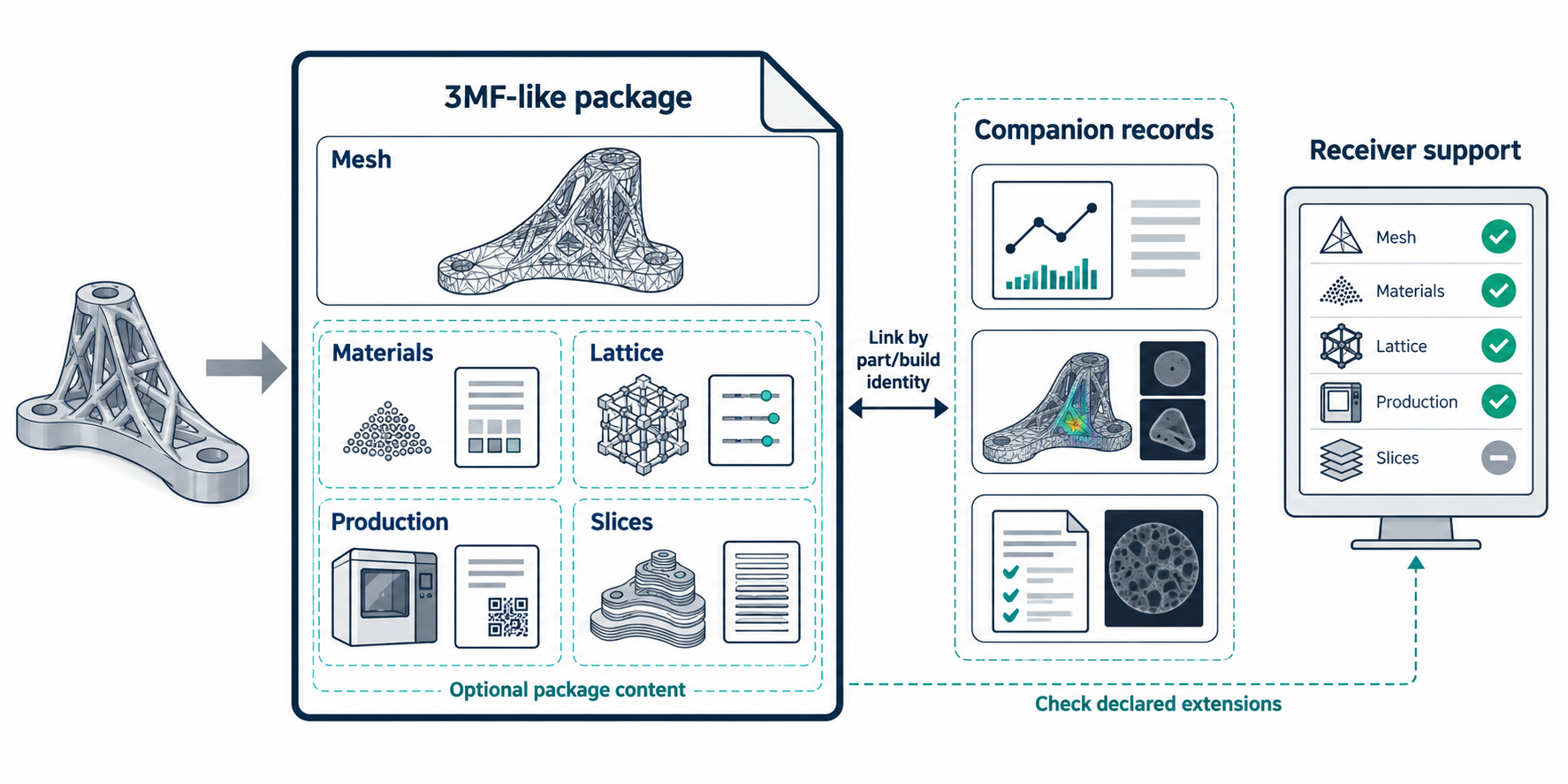
The 3MF suite provides useful examples of why “mesh present” is not a complete additive requirement:
| Payload | What the specification family can represent | What it does not prove |
|---|---|---|
| Materials and properties | Colors, textures and coordinates, composite materials, multiproperties, and display properties assigned through material/property resources | A qualified physical material, a validated process, or a printer’s interpretation of those properties. |
| Beam lattice | Nodes and beams for lattice or truss structures that can be inefficient to express as a dense mesh | That the receiver preserves lattice semantics or uses them in a build. A representation mesh may be for display and preview; the extension prohibits using it to manufacture the part. |
| Production | Build, object, and part-copy identifiers; references to objects in separate model files; package-level relationships and inherited resources | That a receiving workflow resolves the references, retains the identifiers, or supports production scheduling. |
| Slices | Stacks of 2D slices alongside core 3D meshes, including slice-level materials or properties | That a receiving slicer uses the slices. A consumer may process the mesh instead, and a lowres mesh is not accurate enough to regenerate attached slices. |
These are independently specified capabilities. Their existence does not create a universal additive package requirement, and a valid package does not establish printability, material qualification, or production acceptance.
Inspect declarations, relationships, and package access
For a richer 3MF handoff, inspect the package itself before relying on its extension names or file suffix. Review its content-type declarations and OPC relationships, identify referenced model and data parts, and record each extension namespace, version, dependency, and required-extension declaration. Then check that the target receiver supports the exact declarations and can access every referenced part.
| Package finding | What it means for the handoff |
|---|---|
| Boolean Operations or Displacement data | The extension can affect the represented shape. Check its declaration and resulting geometry; the specification does not establish that a target receiver applies it. |
| Toolpath data | The Toolpath Extension describes layer-based motion and exposure. When used, its declaration must be required, and Production must also be declared as required. A machine-specific profile may still be needed. |
| Volumetric or Implicit data | The cited v0.8.0 document is explicitly pre-release and warns that a later published version may not be backward-compatible. Pin the exact revision and recipient support. |
| Secure Content | The extension can encrypt OPC content parts. Confirm that the recipient can obtain access to and use the protected parts and related references. |
The Toolpath document labels itself a Release Candidate while its change history calls v1.0.0 the first published version. A September 21, 2026 Consortium article reported that voting was underway and that the extension was intended to proceed to ISO standardization; it gave no outcome or final publication. Treat the current package namespace and target implementation as facts to verify, not as proof of a stable receiver route.
When the package is broader than 3MF
An additive handoff may need a configured data package in addition to a model file. ISO/ASTM 52951:2026 describes a scenario-specific, modular package that can span design, simulation, tessellation, slicing, build, part or build data, and evaluation data. Its public description is based on metal powder-bed fusion using laser beam (PBF-LB/M) and does not impose a production execution plan. Use that scope to identify the data the actual process and recipient need; do not treat it as a universal package definition.
Process-monitoring and quality-control records may also be companion data. ISO/ASTM 52953:2025 addresses registration of multimodal monitoring and quality-control data for metallic PBF-LB, including use of an appropriate repository. It excludes data cleansing, sensor calibration, and image processing, and does not establish a cross-process route or acceptance link. If monitoring or inspection evidence matters, specify its format, repository, ownership, and link to the relevant part or build separately from the 3MF extension check. See Additive Monitoring and Inspection Data for the companion-record questions.
A bounded sender-side example
Autodesk documents two different Fusion 3MF export contexts. The Design workspace’s Save As Mesh path exports a selected mesh body and offers unit and body-grouping choices. The Manufacture workspace’s 3MF Scene Export can expose additional selections such as supports, machine data, process simulation, and general simulation settings when the selected additive machine provides the relevant capability.
This distinction is useful, but it remains sender-side evidence. The public documentation does not establish the emitted extension namespace or revision, the receiving application, the downstream interpretation, or acceptance of a build. Do not treat the two export paths as equivalent without inspecting the package and the target receiver.
Autodesk’s January 2026 Fusion release notes separately state that build v.2606.1.22 added export of slice data using the 3MF Slice Extension. The note does not name the emitted namespace or revision, describe the slice contents, or identify a receiving slicer or accepted build. Treat it as a bounded sender-side capability statement and inspect the actual package and receiver behavior for a real handoff.
Autodesk’s Netfabb 2025 documentation provides a bounded receiving-side example: it distinguishes machine-specific slicing from machine-independent slicing, and says that importing certain vector slice files brings in geometry while laser power and speed are typically dropped. This is Netfabb-specific behavior, not a general property of slice formats or evidence of a paired Fusion-to-Netfabb acceptance route. Check the exact input format and process parameters in the receiving workflow.
Check the exact version and extension contract
Before sending an additive package, record:
- Core namespace and revision.
- Each included extension, namespace, and revision.
- Whether any extension is marked required.
- The producer path, product release, export direction, and selected options.
- The receiving product, release, importer direction, and supported extensions.
- Whether the receiver consumes the richer payload, falls back to the mesh, or regenerates downstream data.
- The check that confirms the received result serves the intended build task.
Official 3MF sources currently expose a version-label difference for the Production Extension: the Consortium specification landing page lists v1.1.2, while the repository and conformance-test material refer to v1.2 or v1.2.0 in their respective contexts. Treat the package’s declared namespace and the receiver’s support as authoritative for a real exchange; do not choose a revision from a landing-page label alone.
The existence of conformance tests is also not a product result. A test suite can define combinations of core and extension requirements without proving that a particular producer or consumer passed them.
A practical additive handoff checklist
- Define whether the recipient needs a preview mesh, editable model input, build-preparation data, or a production package.
- Preserve the authoritative geometry and distinguish it from a display or representation mesh.
- List required material/property, lattice, production, slice, and support or simulation payload explicitly.
- Inspect the package relationships, identifiers, required extensions, and declared revisions.
- Confirm the target receiver’s support for that exact payload and direction.
- State what the receiver may regenerate, then verify the regenerated result against the intended build or fabrication objective.
For mesh accuracy and topology, see Geometry, Topology, and Mesh Fidelity. For extension and version mechanics, see Formats, Profiles, and Translators. For a named route, see Ecosystem Routes and Collaborative Exchange. For acceptance and reuse checks, see Validation, Exchange Control, and Long-Term Reuse.