A model or build file and its quality companions answer different questions. Monitoring records, post-build inspection, and derived reports may need to be read alongside the selected design and build, but a shared folder or common coordinate system does not by itself link them to the correct part, layer, or physical item. Define those links and their interpretation context for the specific recipient task.
Separate model/build payload from companion records
Identify which artifacts describe geometry or build preparation and which record machine events, sensor measurements, post-build inspection, or derived analysis. For each record, state whether it is raw, transformed, registered, filtered, or summarized; who created it; which software or processing version applies; and which source records it depends on. Keep returned inspection and process results distinct from the design definition and from a build package such as 3MF.
Carry the associations needed for interpretation
| Association | Context to capture | Check before combining records |
|---|---|---|
| Design to build | Authoritative model/configuration/revision, build ID, and process context | Confirm which design state and build generated the evidence. |
| Build to physical part | Part, serial/lot, build position, and any split or post-processing identity | Distinguish a build job from each physical part produced. |
| Part to layer or region | Layer number, region/feature, and spatial coverage | Record whether a measurement applies to a whole part, layer, or selected area. |
| Modality to coordinate frame | Source frame, units, target frame, transform/registration method, and provenance | Confirm that alignment is documented and reproducible for the intended comparison. |
| Acquisition to derived result | Time, sequence, processing/measurement version, and source-data reference | Preserve the relation between original observations and derived values. |
| Result to decision | Characteristic, report, inspection plan, and named use | Do not infer a pass/fail criterion from data registration alone. |
A transform or common frame is only one part of the chain. Preserve units, spatial coverage, orientation, registration method, uncertainty where reported, and enough provenance to tell whether a dataset was reprocessed or re-aligned. If those details are unavailable, mark the association as uncertain rather than reconstructing it from filenames or timestamps.
Read the evidence within its process scope
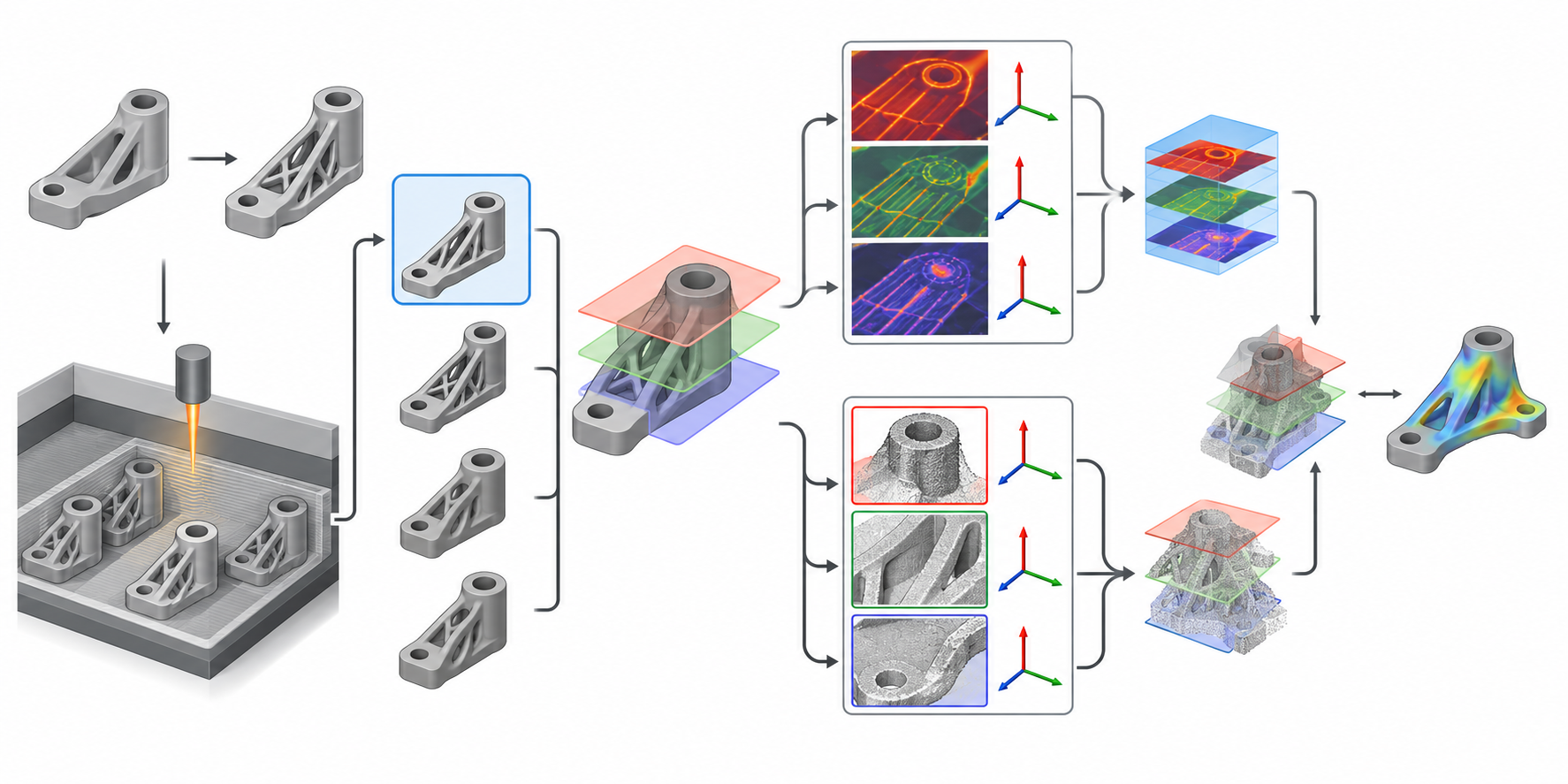
ISO/ASTM 52953:2025 addresses registration of multimodal monitoring and quality-control data for metallic laser powder-bed fusion (PBF-LB) and points to an appropriate data repository. Its public scope does not provide a universal metadata schema; it excludes data cleansing, sensor calibration, and image processing. Apply the relevant clauses and repository needs to the actual process, and keep this standard’s process boundary explicit.
NIST provides a bounded research example in AMS 100-69: a dataset from NIST laser-PBF testbed builds combines process-monitoring and ex-situ XCT data, aligns features to the machine coordinate system, organizes values by part and layer, and reports uncertainty. A related NIST paper describes a registration method connecting scan paths, in-situ imagery, XCT, coordinate measurements, and CAD. These examples show why frame, part/layer identity, modality, and processing provenance matter. They do not define a commercial exchange profile, universal required fields, or acceptance thresholds.
Define repository and access dependencies
For every linked file or record, name its storage location or repository, identifier, access owner, retention needs, and any external path or software dependency. State whether the receiver gets the data itself, a stable reference, or only a report. A link that works for the sender may not resolve for the receiver. Record which associations are transferred, reconstructed, or unavailable, and how a receiver can verify the source and derived forms.
Use a companion-data brief
Authoritative design/configuration/revision:
Build, physical part, serial/lot, and build position:
Monitoring source, modality, time/layer/region coverage:
Post-build inspection and derived reports:
Source and target coordinate frames, units, and registration provenance:
Measurement/processing version, uncertainty, and source-data references:
Repository, access owner, and external dependencies:
Transferred, reconstructed, and unavailable associations:
Receiving comparison and intended decision:
Use this brief to identify missing context, not to prescribe sensor setup, calibration, image processing, defect detection, process tuning, or part qualification. Registration can make measurements spatially comparable; it does not prove that the intended physical part passed an acceptance decision.
For model, material, lattice, production, and slice payload, see Additive-Manufacturing Exchange Beyond the Mesh. For identity correspondence across design, plan, and result, see Design-to-Inspection Identity Links.