A reference model is useful when the recipient needs a bounded representation for coordination, review, or context. It is not automatically the source model, an editable authoring model, a complete BIM dataset, or an accepted project delivery.
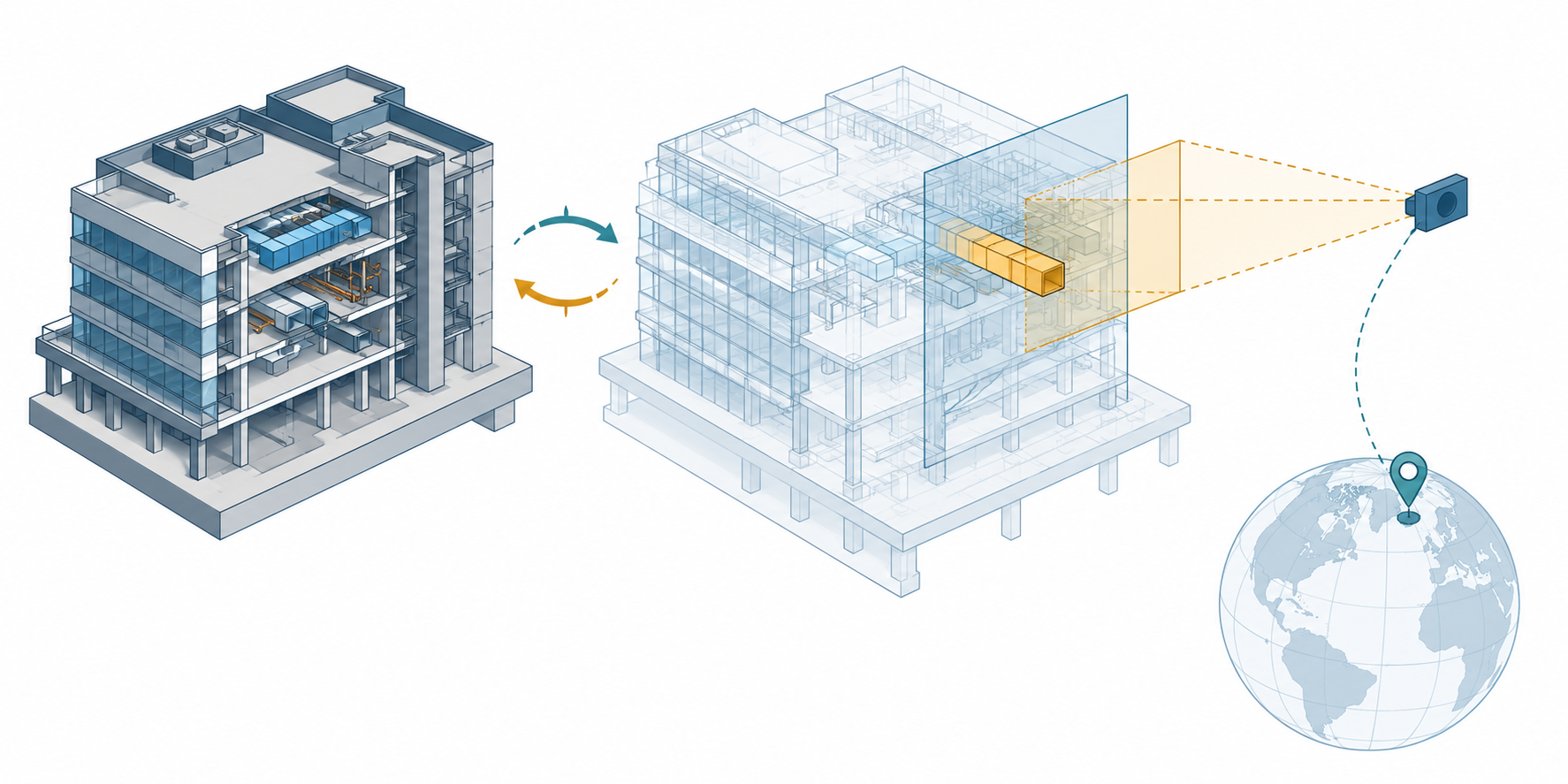
Define the reference purpose
Before sending or consuming a reference model, record the downstream objective. Examples include spatial coordination, design review, context for another discipline, or a handover view with a stated information scope. The objective determines what must be present and what can be excluded.
At minimum, declare:
- IFC release and status;
- model view or profile and its stated purpose;
- coordinate frames, units, placement, and georeferencing context;
- required geometry and spatial structure;
- required identities, classifications, properties, or relationships;
- excluded information such as parametric history or application-specific constraints;
- source ownership and the authoritative model for edits;
- version, issue date, and update relationship; and
- evidence that will demonstrate suitability for the stated use.
The IFC exchange-scope article explains why the release and model view must be named. The IDS article covers how selected information requirements can be made explicit.
What a model view tells you—and what it does not
buildingSMART describes Model View Definitions as purpose-specific interpretations of IFC. Its database lists Reference View and Coordination View examples with final status and design-coordination purposes, as well as a Design Transfer View marked Draft and described as higher-fidelity one-way transfer rather than a round trip.
That information helps bound the intended representation. A view name does not prove that a particular exporter or importer implements the view, that every project-required property is included, or that the result remains editable. The exact schema, view, product versions, direction, and dataset still matter.
Opening and overlaying are weak evidence
If a model opens, you have evidence that a particular application produced a displayable result. If it overlays another model, you have evidence of visual coincidence in that viewing context. Neither observation alone establishes:
- correct units, axes, or coordinate transforms;
- complete spatial containment or object relationships;
- correct classifications or property values;
- retained parametric history, constraints, or design intent;
- suitability for quantities, analysis, facilities, fabrication, or handover; or
- acceptance against the recipient’s requirements.
The semantic layers article, When Geometry Arrives but BIM Meaning Does Not, provides a more detailed loss boundary. A reference model can intentionally omit many of those layers and still be useful; the omission must be explicit.
Spatial structure has its own boundary. In IFC, an element has one primary spatial containment relationship, while additional spatial references can associate it with other levels where it is relevant. A model that displays a spanning element in the expected place does not by itself show that both its primary containment and its cross-level references survived the exchange.
Issue viewpoints stay tied to model context
BCF-XML 3.0 represents issue-view context such as a camera, clipping planes, components, and annotations for a referenced model state. Those values help a team see what an issue concerns; they do not identify a CRS or geodetically position the BIM model. Record the model revision and source state that the viewpoint refers to, especially when the model is updated. The BCF representation does not prove that a receiving product keeps component identity or that the referenced model is correctly located. Detailed issue routes belong to the portal’s product-route coverage.
Keep the source of truth clear
Treat the reference as an input to the recipient’s task, not as an invitation to edit the sender’s authoritative design in place. Record which model owns design decisions, which version was exchanged, and how updates are identified. If the recipient creates local annotations, clash results, or coordination decisions, keep them distinguishable from source geometry and source properties.
Do not assume that an edited copy can be round-tripped to the source. A model-view description, a file that opens, or a certification result does not establish preservation of authoring history or a safe update path.
Certification is bounded test evidence
buildingSMART describes its certification program as using export/import test cases, automatic and regression testing, manual verification checklists, calibration files, and reporting for specific exchange requirements associated with an official IFC Model View. Its validation service is described as a way to test and debug export/import functions.
This is useful evidence about a declared test environment. It is not a universal guarantee for every product version, release, direction, model view, project, or semantic layer. Certification or validation evidence should be attached to the exact scope tested and then compared with the recipient’s actual requirements.
Choose the right boundary
| Recipient need | Reference model may be sufficient when… | Do not assume… |
|---|---|---|
| Coordination context | stated geometry, placement, and coordination scope are available | the model is editable or semantically complete |
| Design review | the review questions and required objects/properties are declared | every source relationship or property survived |
| Quantity or analysis input | the relevant objects, classifications, properties, units, and validation evidence are present | visual completeness proves quantitative suitability |
| Downstream authoring | an explicitly tested route establishes the required editable behavior | a reference view or imported geometry recreates design intent |
| Formal handover | the delivery meets a declared release, view, requirement set, and acceptance process | opening the file is acceptance |
When the model is only context, label it as context. When a recipient needs an editable source, use the portal’s Editability and Design Intent coverage to define that boundary. When a recipient needs a formal handover, define those requirements separately and route the exchange through the appropriate product, format, and validation evidence.