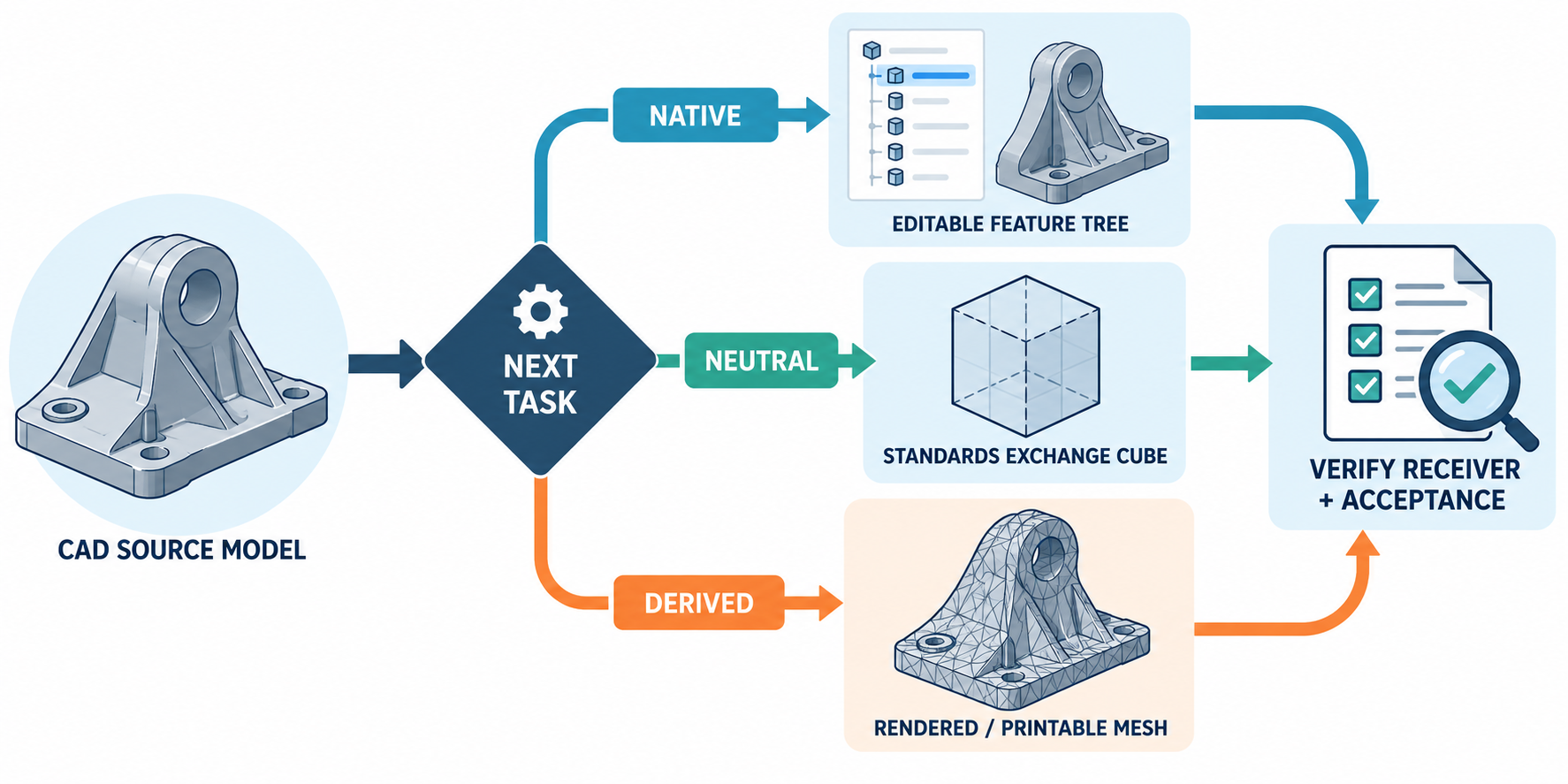
The best representation is the one that carries the information the next task needs with an acceptable amount of translation risk. “Native,” “neutral,” and “derived” describe different exchange strategies; they are not quality rankings.
Start with the next operation
Write down the destination task before choosing a format:
- What must remain exact: shape, topology, assembly identity, parameters, annotations, materials, coordinates, scene data, or production data?
- What may be re-created or omitted?
- Which operations must work after receipt: edit, measure, coordinate, render, print, inspect, machine, or archive?
- What evidence will show that the result is acceptable?
This prevents a visually convincing export from being mistaken for an editable or manufacturing-ready handoff.
Native or proprietary authoring representations
A native representation is tied to an authoring ecosystem. It may carry relationships that make the source model productive to continue editing: features, parameters, constraints, history, configurations, or product-specific metadata. That same relationship to the ecosystem can make the representation dependent on a product release, licensing context, referenced files, or a compatible reader.
Native is therefore a useful candidate when the receiver is expected to continue authoring in a compatible environment. It is not proof that another release can open the file or that the receiver will preserve every authoring concept. Confirm the source and destination releases, referenced dependencies, and the operations the receiver must perform.
Neutral standardized exchange representations
A neutral representation defines a shared contract intended to cross product boundaries. ISO’s overview of the ISO 10303 series, for example, describes a family of architectures, data-specification methods, application protocols, implementation methods, and conformance-testing concepts. The existence of that contract can reduce dependence on one authoring product, but it does not make every implementation equivalent.
Neutral still has scope. Identify the schema, application protocol, profile, model view, extension, version, and direction. Then test the information layers that matter. A neutral representation may be an excellent shape handoff and an inadequate transfer of feature history, or a useful coordination exchange whose exact information requirements depend on the selected view.
Derived or task-oriented delivery representations
A derived representation is produced for a particular delivery task rather than to preserve the source authoring model. Omitting authoring information can be a deliberate design choice when the receiver needs a runtime scene, a print build, a viewable mesh, or another bounded result.
The glTF specification is explicit that glTF is not an authoring format and deliberately does not retain 3D authoring information. It is designed as a runtime-oriented asset representation, so it should be evaluated against scene delivery and rendering needs rather than continued parametric editing.
The 3MF Consortium presents 3MF as a 3D-printing format and publishes a core specification with purpose-specific extensions. That makes it a useful example of a task-oriented representation. It does not prove that a named printer, application, or route preserves all desired information, and the exact core or extension version still matters.
Compare families by purpose
| Next job | Candidate family to investigate | Information to verify before sending |
|---|---|---|
| Continue feature-based authoring | Native first; neutral only if the receiving workflow can rebuild or accept the lost intent | Features, parameters, constraints, history, configurations, references, and release compatibility |
| Exchange exact shape for coordination or measurement | Neutral product-data representation or another exact-geometry route | Units, topology, tolerances, entity scope, validation operations, and destination interpretation |
| Coordinate a building model | A scoped building-data representation | Exact release, schema/view or information requirement, object classes, properties, and implementation support |
| Render or review a scene | Derived scene delivery or a neutral scene representation | Scene hierarchy, materials, textures, cameras, animations, external resources, and runtime support |
| Manufacture or print a part | Task-oriented production representation or a route proven for the production system | Build scope, units, materials, process data, machine interpretation, and acceptance checks |
| Fabricate or assemble a PCB | A requested combination of layer images, job metadata, drill/rout files, or a structured PCB description | Required layers and attributes, electrical/design state, file set, revisions, and receiver requirements |
| Preserve for later retrieval | A package strategy that retains the data layers and dependencies needed later | Version, profiles, resources, source context, validation evidence, and a readable manifest |
The table names candidates, not recommendations. The receiving task, product support, representation scope, and validation evidence decide whether a candidate is suitable.
A 3D board or enclosure representation can answer a mechanical-fit question, but it does not replace the layer, connectivity, drill/rout, or manufacturing-description data a PCB supplier may require. Gerber, a job file, ODB++, and IPC-2581 describe different file or model roles; ask for the needed representation set instead of treating them as interchangeable. See PCB fabrication representation choices for the format-specific questions. Electrical payload requirements and production acceptance remain separate domain checks.
The decision record
Before committing to a route, record:
- the source authoring environment and release;
- the proposed representation and exact release or profile;
- the information layers that must survive;
- the known omissions or intentional derivations;
- the receiver’s supported direction and release;
- the dependencies and package contents; and
- the acceptance checks for the next task.
If the source and destination need different information, a single export may not be enough. A native authoring file, a neutral exchange file, and a task-oriented derivative can be complementary deliverables when each has a stated purpose and a controlled relationship to the others.
Continue the evaluation
Read what a file label tells you before selecting a scoped representation. Then review schemas, model views, and extensions and translation mechanics to understand the implementation work behind the chosen family.
Key points
- Choose by the next operation and required information layers.
- Native, neutral, and derived are strategies, not fidelity grades.
- A task-oriented representation may intentionally omit authoring information.
- Exact scope, product direction, version, dependencies, and acceptance still need independent verification.