A visual scene is often a graph of relationships, not a folder of independent meshes. Parent transforms, instances, layer opinions, references, payloads, variants, overrides, and asset paths can all affect the scene a receiver resolves. Flattening may make delivery easier, but it changes which relationships remain available.
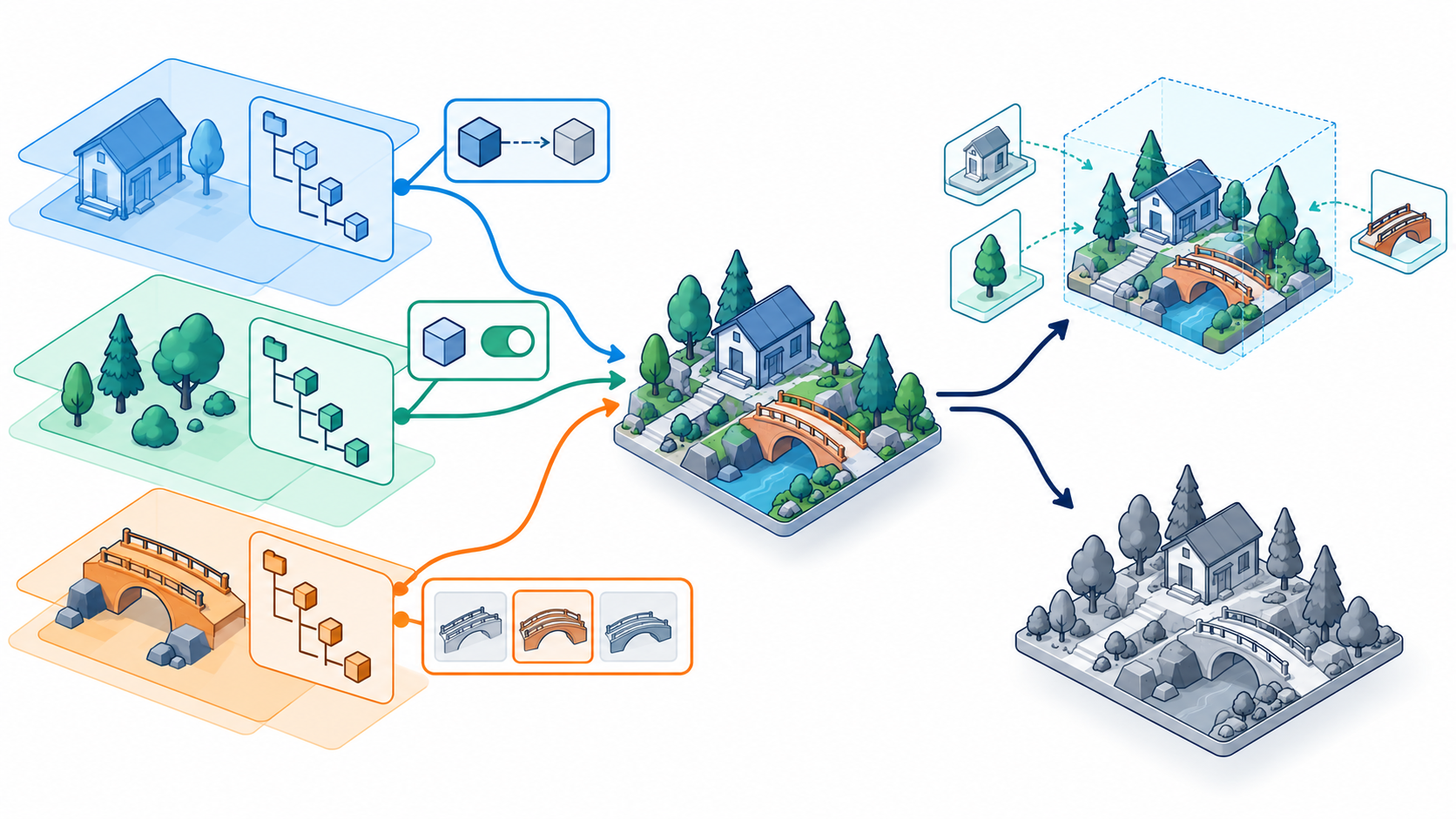
The scene graph carries meaning
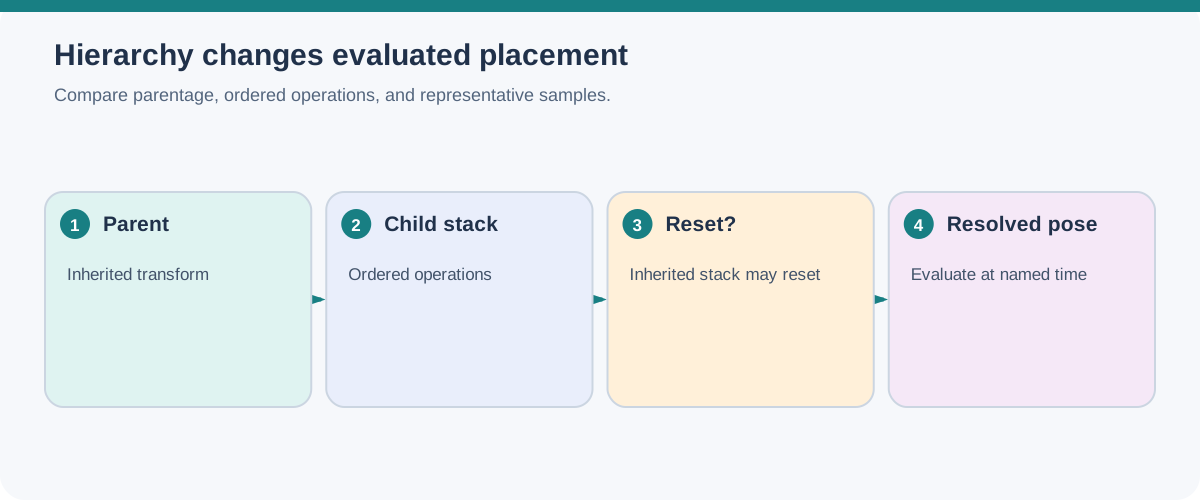
At the visible level, a scene graph describes objects and their hierarchy. A child’s transform is interpreted in relation to its parent. Reuse through instances can keep repeated assets connected to a common source. Names and namespaces let a recipient identify the object that a camera, material, animation, or downstream override targets.
In USD, these visible relationships are combined with composition arcs:
| Mechanism | What it contributes | What to verify |
|---|---|---|
Layers and subLayers |
Ordered, nestable opinions that contribute to a layer stack. | Which layers are present, their order, and the resolved opinion for critical properties. |
| Reference | Composes a target prim tree into another prim. | The target path, referenced file, namespace, and resolved geometry or assets. |
| Payload | Defers a reference so a client can load or unload part of the scene. | The initial load state, the parts required for the task, and behavior when the payload is loaded. |
| Variant set | Bundles alternatives that a consumer can select. | Selected variant, available alternatives, and whether the receiver exposes the selection. |
| Override | Supplies a stronger opinion over an existing composed value. | Which layer supplies the override and whether it survives the chosen delivery operation. |
| Asset path | Names an external file or other resource for the resolver to locate. | The path, resolver, search paths, and context available to the recipient. |
| Transform stack | Records ordered component operations and whether inherited transforms are reset. | Operation order, reset state, hierarchy, and representative time samples. |
| Point instancer | Connects ordered prototypes to per-instance indices, transforms, identities, and masks. | Prototype order, protoIndices, positions/orientations/scales, IDs, masks, and time-varying state. |
The important question is not whether the source contains a file with the expected extension. It is whether the receiver can resolve the same relationships and select the same state.
Record the saved source state
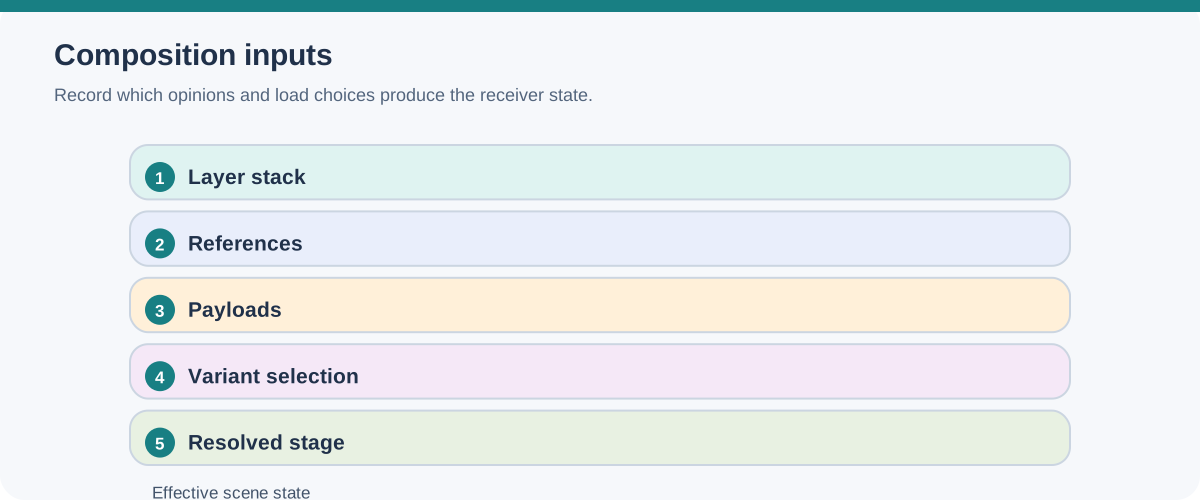
Before comparing scenes, name the root layer or project entry point, any stable public prim paths used by downstream references or overrides, and the selected layer/load state. Record which opinions were saved to delivered files and which existed only in the live application session. A visible edit in a working scene is not proof that its layer or dependency was written into the package.
The distinction can be application-specific. For example, 3ds Max’s USD Layer Editor documents choices that save the host scene with USD layer files, keep USD edits inside the host scene without writing them back to USD files, or save only the host scene and discard those USD edits. VRED 2026 separately exposes smart-reference load policies and live-reference path locations. These examples are not USD-wide semantics: record the selected save/load policy and reopen the delivered files to confirm the actual composed state.
References and payloads are not interchangeable
A reference assembles a target tree into the referencing prim. A payload is a deferred reference that can be selectively loaded after a stage opens. This makes a payload useful for managing a working set, especially in a large scene, but it also introduces a load-state requirement for the handoff.
If the delivery test checks only the initially visible portion of a scene, it may miss a payload that contains a required asset, animation, or high-detail variant. Test the load state that the recipient will actually use, and record whether the scene was inspected with the relevant payloads loaded.
Instances need more than a count
An instanced scene can look plausible while its instance relationships have changed. USD UsdGeomPointInstancer keeps an ordered relationship to prototype prims or subtrees. Each instance selects a prototype with protoIndices and carries per-instance positions, orientations, and scales; optional IDs, velocities, and invisible or inactive ID masks add more state.
Compare the prototype relationship and ordering before comparing the visible result. Check that every index still selects the intended prototype, that per-instance arrays align, and that IDs and masks have the expected effect at the tested time. Expanding instances may be acceptable for a static delivery, but record that as a deliberate representation change rather than treating the expanded mesh count as proof of preservation.
Variants are finite states, not generic configurators
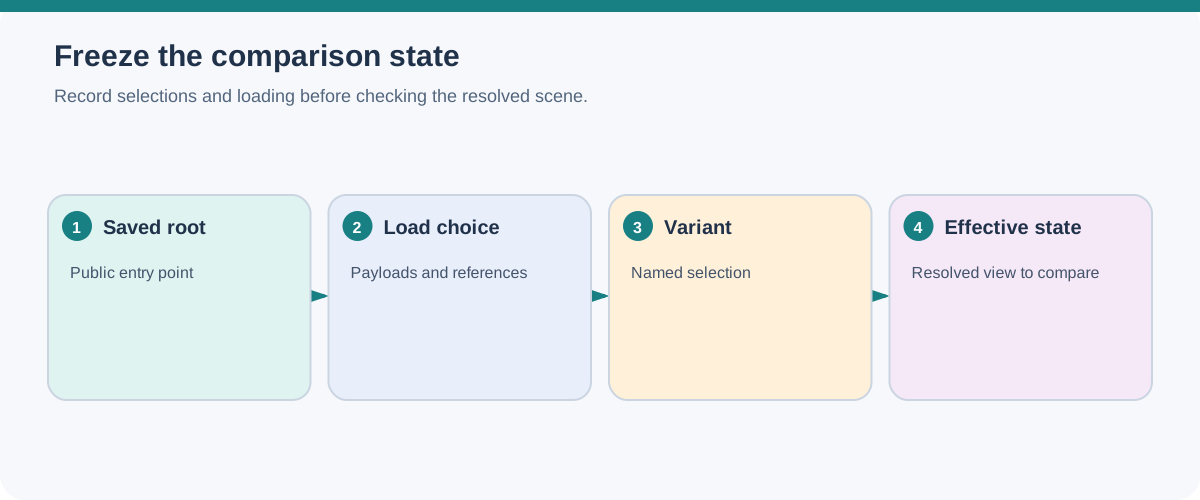
An OpenUSD VariantSet can bundle alternatives that a stronger layer selects without rewriting the source asset. The selection is part of the resolved state and should be recorded with the layer that supplies it. In glTF, the ratified KHR_materials_variants extension is narrower: it describes finite, premade, asset-level material choices through named root variants and primitive-level mappings. A conforming viewer can apply at most one active variant per asset instance, and primitives without a mapping fall back to ordinary glTF behavior.
Treat those mechanisms as different contracts. Test every required selection, its mapped primitives, and its fallback state in the named receiver. The extension’s ratified status or a valid VariantSet does not establish that an importer or renderer exposes the same choices.
Transform operation order is part of the scene
For USD transformable prims, xformOpOrder records the ordered component operations used to position a prim and its descendants. A prim may reset its inherited transform stack, and operation values may vary at authored times. Comparing only one final matrix can miss a changed order, inherited parent relationship, or animated sample.
When transforms are material to the handoff, compare the operation order, reset-stack state, local-to-parent or local-to-world result, and representative named times. If the receiving representation intentionally bakes these into matrices, retain the source composition or transform description when later edits or diagnosis may depend on it.
What flattening changes
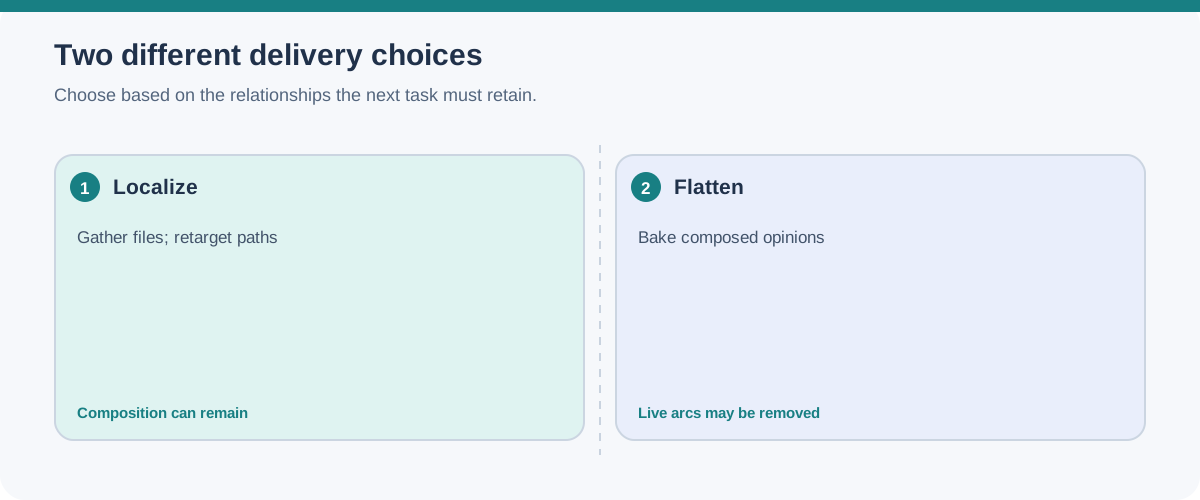
USD flattening bakes composition into a single layer that no longer contains the original composition arcs. That can simplify transport and produce a self-contained result, but it can also remove the live relationships that made the source scene maintainable or selectable.
Flattening can also change delivery characteristics:
- repeated referenced data may be duplicated rather than shared;
- the resulting file may become much larger;
- the operation can be memory- and compute-intensive; and
- a receiver may gain a simple layer while losing the ability to update a source reference, switch a variant, or apply a layer-specific override.
The result is not automatically worse. It is a different deliverable. Flatten when the recipient needs a resolved snapshot and the loss of live composition is acceptable. Preserve the composed source when later updates, variant selection, dependency inspection, or selective loading matters.
Separate authored hierarchy from evaluated and runtime state
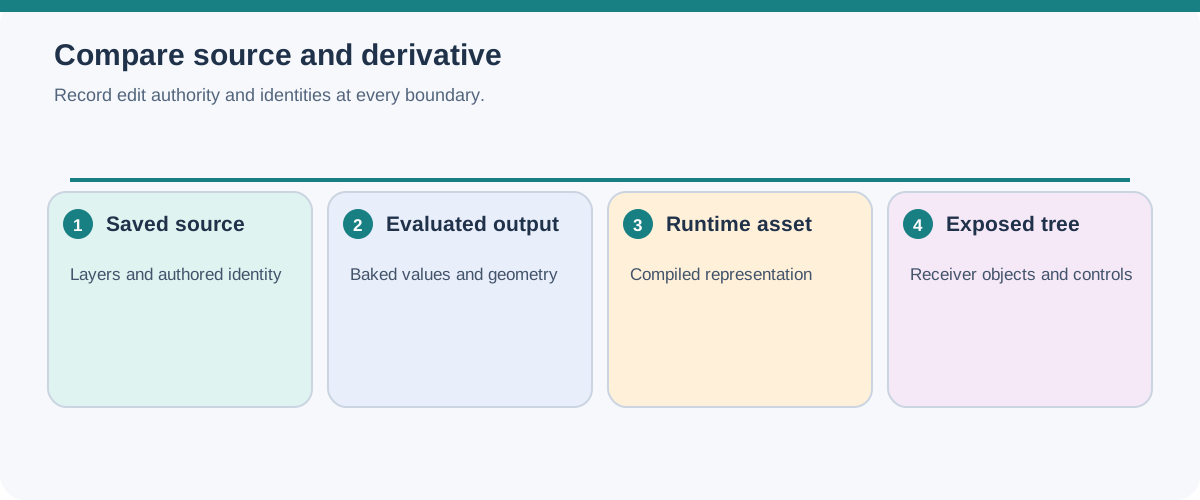
The hierarchy a user sees in the source application may not be the hierarchy delivered or exposed at runtime. Exporters and importers can evaluate, flatten, merge, filter, or reorganize a scene under named options. Record both the source hierarchy and the receiver’s resulting hierarchy, plus the evaluation mode that produced it.
For example, Blender’s Alembic exporter exposes Flatten Hierarchy separately from Use Settings for Render or Use Settings for Viewport. Flattening changes parent relationships by writing world-space coordinates; evaluation settings select which visibility and modifier state is used. Blender’s USD exporter separately exposes evaluation, path, unit/orientation, and Xform-operation choices. These choices affect what state is represented, so record them instead of treating “exported USD/Alembic” as a complete description.
An Unreal Engine 5.8 Datasmith import is another bounded example. Its import process can flatten nested layers, adjust unit scale to preserve real-world size, and translate transform animation to Level Sequences; parent non-uniform scale with compensated child pivots can produce a mismatch. The Datasmith Runtime plugin also offers None, Simplified, and Unfiltered hierarchy choices; None keeps the hierarchy inside the runtime actor rather than exposing it in the World Outliner. Deltagen-specific import options can merge subtrees, reuse duplicates, remove hidden nodes, or simplify hierarchy. These are product and path-specific behaviors, not universal rules for scene formats. Pin the engine, importer/plugin, source format, and options, then compare the actual loaded scene.
VRED 2026’s documented import options provide a separate example: its importer can retessellate geometry, merge objects, reset transforms, and reorganize layers. Which controls apply depends on the incoming format. Record the source format and selected options, then inspect the resulting geometry and hierarchy; the documentation does not establish a transfer result for a particular scene.
Previews, proxies, and bounds are not render evidence
USD can store thumbnail preview paths, UI hints, model draw modes, and cached extents for browsing or faster queries. Those data serve different purposes: an ObjectHints hidden hint is UI-only; model draw modes such as bounds or cards can substitute for subtrees in an imaging view; cached extents describe bounds rather than proving payload load or rendered geometry. A thumbnail is also only a preview. None of these alone establishes render visibility or the intended image.
During acceptance, load the required payloads and inspect the intended render or runtime mode. If an object appears absent, check the selected draw mode, UI filters, load state, and cached bounds before diagnosing missing source geometry. Preserve the exact receiver and view conditions in the test record.
Localization is a different choice
Localization gathers scattered layers into a coherent file tree and retargets references, payloads, and other asset paths to the copied files. Unlike flattening, it does not bake the whole composition into one layer. It can therefore retain more of the source relationships while making the dependency tree easier to move.
Localization still requires inspection. A retargeted path can be syntactically valid but unusable in a recipient with a different resolver, search path, package layout, or context. A package that contains the root layer can still name resources outside its boundary.
Compare the source and delivery states
Before and after flattening or localization, record the following:
- Open the source with the intended load state and record the resolved root, active layers, payloads, references, and variant selections.
- Compare hierarchy, namespaces, transform-operation order, reset state, representative time samples, instance prototypes, instance count, and object identity.
- Check that the selected variants, primitive mappings, and important overrides produce the intended result.
- Resolve every asset path from a clean copy or clean receiver context. Do not rely on the author’s search paths.
- Load the same payloads and inspect the same views, materials, cameras, and animation clips.
- Record what was deliberately baked, expanded, removed, or left dependent on a resolver.
Keep the composed source beside a delivery derivative when the next workflow may need updates or alternate variants. The derivative can be the convenient handoff; it should not become the only copy if its flattening decision removed relationships that later work depends on.
For the dependency and clean-receiver side of this comparison, see Package and Test a Visual Scene Handoff. For surface relationships that can also be affected by composition, see Materials, Textures, UVs, and Shader Bindings.