Inspection is not only a question of whether a measurement system can open a shape. The recipient also needs to know what characteristics matter, how they are intended to be measured, which resources or templates apply, and where the results belong. An inspection-ready handoff therefore has a traceability problem as well as a geometry problem.
Separate the quality-information layers
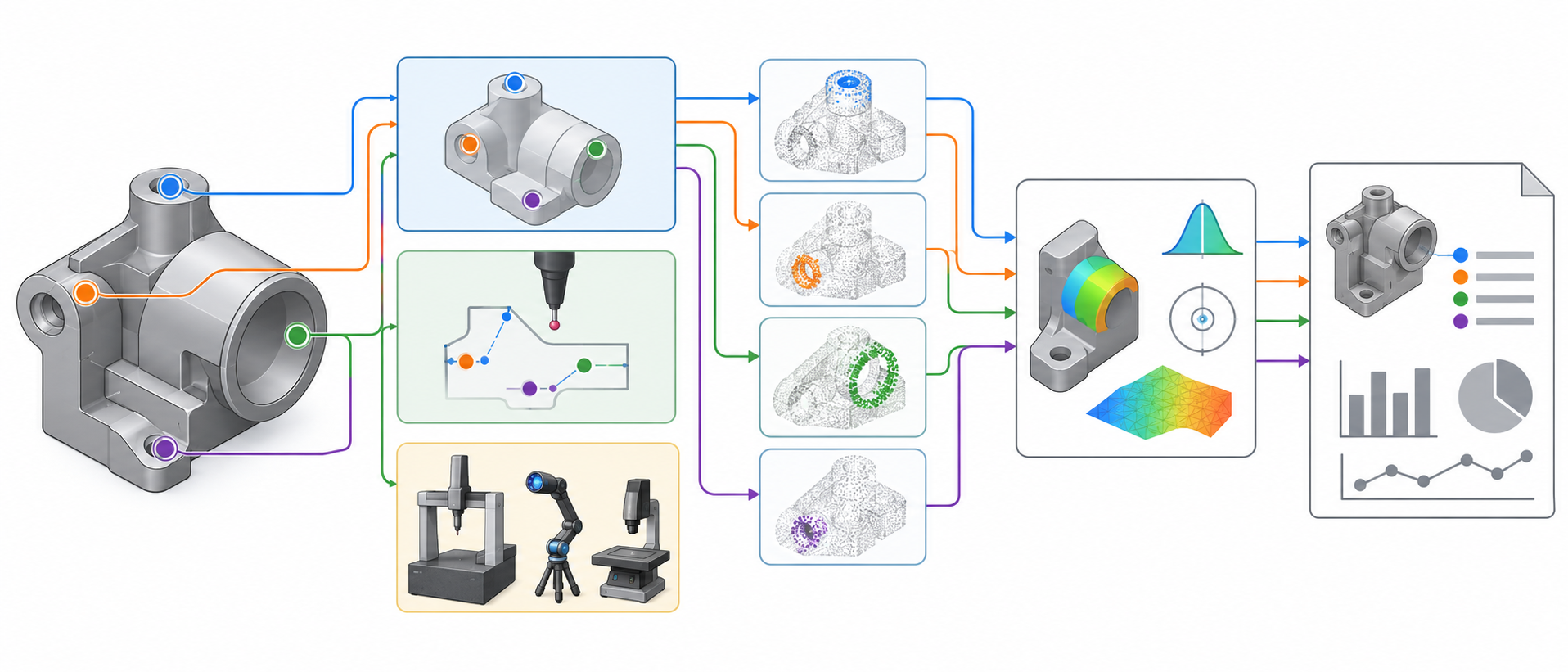
Treat these as related but distinct artifacts:
| Layer | Purpose in the handoff | Question to verify |
|---|---|---|
| Geometry and design definition | Identifies the part and the form being evaluated | Is the correct revision, coordinate context, and usable geometry present? |
| PMI and characteristics | Expresses dimensions, tolerances, datums, surface or process requirements, and their associations | Is the information semantic and linked to the intended geometry, or merely displayed graphics? |
| Measurement plan | States what and how to measure | Did the plan transfer, or will the recipient create it locally? |
| Resources and templates | Provides measurement, reporting, or execution context | Are the referenced resources available and compatible with the recipient? |
| Execution results | Records observations or measurements | Are results linked to the correct characteristic, part, revision, and plan? |
| Analysis and reporting | Summarizes or communicates the outcome | Can the report be regenerated or audited from the transferred relationships? |
NIST describes QIF as an integrated set of XML information models spanning product design, inspection planning, execution, analysis, and reporting. DMSC describes QIF as a CAD-agnostic XML platform and standard that organizes and associates geometry, PMI, plans, resources, results, and statistical analysis. Those descriptions support a linked quality-information chain; they do not prove that a particular CAD, CMM, planning, or reporting product supports every module.
Semantic PMI is not the same as a picture
An annotation that looks correct on screen may not carry the structured association a receiving system needs. Ask separately whether the transfer preserves:
- the characteristic or identifier;
- its value, tolerance, datum, or other qualification;
- its association with the intended geometry;
- the revision and coordinate context; and
- the relationship to the plan and eventual result.
Sender documentation also needs an exact version and assembly-level check. Autodesk Inventor 2026’s STEP export-options page says AP242 is not available for assemblies, while a separate update says semantic assembly annotations can be exported to JT/STEP at top-level and part-level; part-level annotations are invisible, and thread notes and 3D welding annotations are not semantic. The pages do not reconcile their scopes or settings. For an assembly handoff, verify the exact export command, format/profile, annotation level, and generated file instead of treating either statement as proof of a particular transfer.
NIST’s QIF PMI Report software is a bounded example of this distinction. Its documented behavior generates a spreadsheet from semantic PMI in a QIF file, reports measurements and QPids, and does not process graphical PMI. That is a limitation of that tool, not a universal statement that every QIF consumer handles PMI in the same way.
Keep characteristic identity attached to verification
DMSC’s Model-Based Characteristics (MBC) 1.0 defines a product-characteristic identity pattern that pairs a human-readable tag with a persistent, machine-readable UUID. Optional augmentations can associate a characteristic with criticality, a product requirement, or a verification-plan requirement. For a handoff, check that required tags, UUIDs, and associations remain linked from the product definition through planning and reported results. The model defines these relationships; it does not prove that a particular exporter, translator, or inspection system preserves them.
Check the chain, not just the file
For a proposed exchange, record the following before the recipient relies on it:
- Design source: Which model, drawing, or master definition is authoritative, and which revision is being measured?
- PMI representation: Are the characteristics semantic, graphical, or a combination? Which associations and identifiers are required?
- Plan and resources: Is the measurement plan transferred? Which templates, fixtures, devices, or other resources are referenced, and who supplies missing items?
- Results: How will each result link back to the characteristic, plan, part, and revision? Are results transferred, generated, or both?
- Schema and profile: What QIF version, namespace, profile, and product release are involved in each direction?
- Acceptance: What check proves that the receiving system preserved the associations needed for the stated inspection purpose?
Version status needs an explicit check
The DMSC page accessed for this guide labels ANSI QIF 3.0, released in December 2018, as the latest version available from its public download page. Its separate QIF 4.0 page describes a working-group development effort dated to 2023; that page does not establish a released or implemented QIF 4.0 route. For a real exchange, verify the exact version and profile accepted by the recipient instead of inferring status from the name “QIF.”
The same discipline applies to any non-QIF route. A standardized information model can describe relationships without proving that a named sender preserves them or that a named recipient accepts them.
Result intake can change what is compared
Autodesk Fusion Manufacture’s inspection-results reference documents a
product-specific import choice: import all result sets marked START or only
the last set. For Inspect Surface results, a projection option changes the
deviation calculation by projecting the actual contact point to the nearest
nominal CAD surface; with projection off, the comparison is to the nominal
position. Record these settings when interpreting the displayed result. The
help page does not identify a standard result-file schema, prove identity
preservation across systems, or define quality acceptance.
For a correspondence-focused worksheet that separates part, characteristic, plan, execution, and result identity, see Design-to-Inspection Identity Links. For additive monitoring and post-build inspection records with coordinate and layer context, see Additive Monitoring and Inspection Data.
A compact inspection handoff brief
Authoritative design and revision:
Required characteristics and associations:
PMI representation: semantic / graphical / both
Measurement plan and resources:
Transferred results and linkage:
QIF or other schema/profile and product releases:
Recipient regeneration responsibilities:
Acceptance checks for identifiers, associations, and results:
Do not call the handoff inspection-ready until the blank fields are resolved for the stated recipient and task. If a field is intentionally regenerated, name the responsible party and preserve the link back to the authoritative design definition.
For a broader package inventory, see Supplier Fabrication Packages. For the geometry-only boundary, see Manufacturing-Ready vs. Geometry-Only CAD Handoffs. For general acceptance and long-term reuse, see Validation, Exchange Control, and Long-Term Reuse.