“Manufacturing-ready” has no useful meaning without a named downstream task. A file may contain an accurate shape for a CAM programmer, but not the process plan, machine context, or inspection information that another recipient needs. Treat readiness as a claim about a source, a transfer, a recipient, and an objective—not as a property guaranteed by a file extension.
What a successful import does—and does not—prove
Opening a file proves that the receiving software accepted some part of its representation. It does not by itself prove that the intended units, topology, design annotations, manufacturing intent, dependencies, or quality relationships survived. It also does not prove that the recipient can use the result without rebuilding operations or checking the physical output.
For example, ISO 14649-10 describes an interface between a programming system, such as a CAM or shop-floor programming system, and a computerized numerical controller. Its general process-data scope includes geometric and technological information, working-step sequence, and associated machine functions. That model scope is different from evidence that a particular CAD, CAM system, postprocessor, controller, or shop accepts a given transfer.
QIF illustrates the same distinction for quality information. Its model organizes relationships among geometry and product manufacturing information (PMI), measurement plans, resources, results, and analysis. A geometric file alone cannot demonstrate that those relationships are present or usable.
Electronics manufacturing examples make the layers visible in a different domain. IPC-2581C’s public scope describes an XML file for printed-board and printed-board-assembly manufacturing, assembly, and inspection information. IPC also describes a particular PCB design-for-manufacturing workflow in which a user selects a DFM profile and receives reported deviations, while its CFX qualification listing is tied to an equipment model, software version, and declared capabilities. These describe different things: a design-data scope, a selected design check, and a qualified equipment interface. None proves that a board was accepted or that a specific CAD-to-fabrication route preserved all required data.
Wire-harness process records add another boundary. OPC 40570 v1.0.0 describes returned process outputs such as crimp measurements and force curves, cut length, seal position, and stripping length; when a process-output subtype is used in result data, the specification calls for an overall result evaluation. That operational result model does not map itself to electrical connectivity or establish acceptance of a manufactured harness. Keep the design definition, the process execution, and the returned measurement associations explicit.
Inventory the information layers
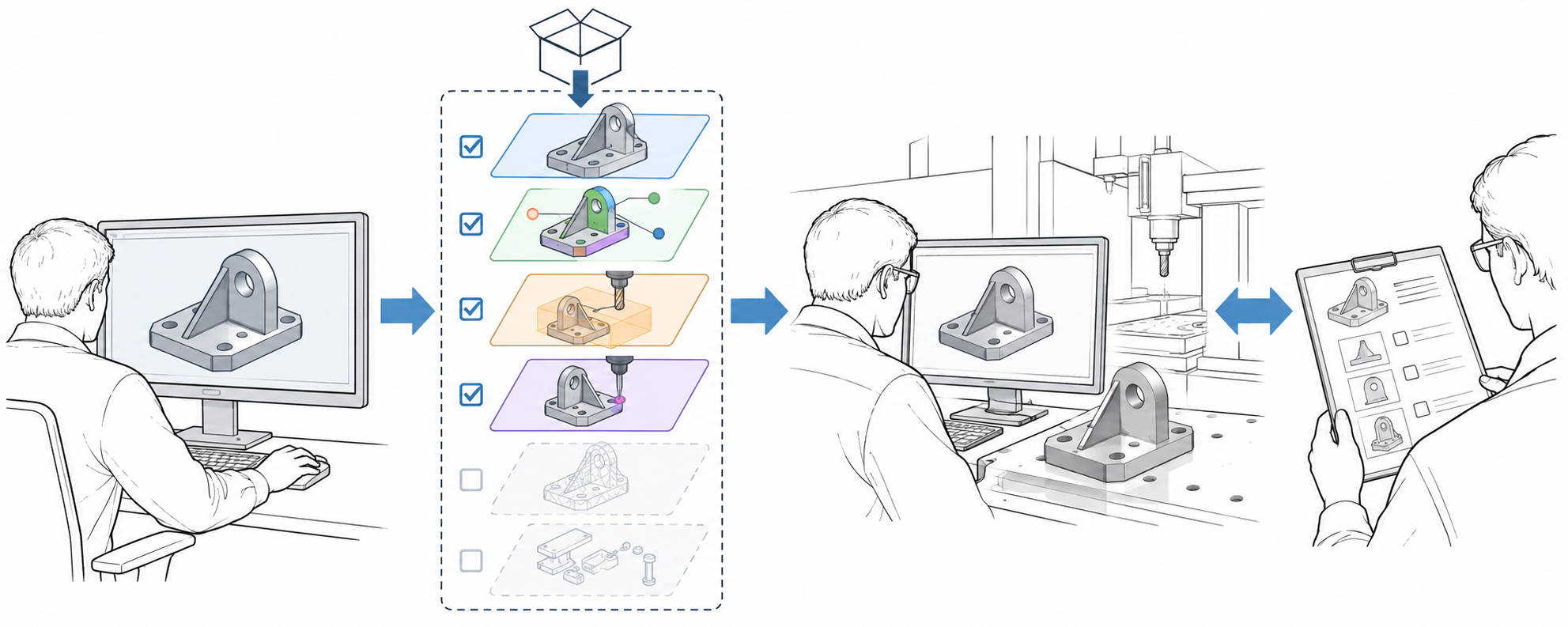
Use this inventory before choosing a route. Not every handoff needs every layer, and the table is a set of questions rather than a universal package requirement.
| Information layer | Question for the recipient | Typical transfer risk |
|---|---|---|
| Geometry and topology | Is the shape usable for the next operation, including units, orientation, tolerances, and geometric health? | A model opens but has changed scale, missing faces, or repair that alters the intended result. |
| Engineering semantics | Which dimensions, tolerances, datums, materials, finishes, or notes govern the result? | A visual annotation survives while its semantic association or identifier does not. |
| Process and tool context | Are workplans, working steps, machine functions, tools, setups, and orientations transferred or rebuilt? | A programmer receives shape only and silently assumes that process intent came with it. |
| Additive payload | Does the task depend on materials, properties, lattices, production identity, supports, or slices? | A mesh is treated as equivalent to a machine- or build-specific package. |
| Inspection information | What must be measured, with which resources, against which characteristics, and where do results belong? | Results cannot be linked back to the design definition or the intended plan. |
| Dependencies and version context | Which external references, profiles, extensions, and releases must the recipient resolve? | A package looks complete but a linked object, extension, or schema revision is unsupported. |
| Acceptance evidence | What check shows that the received data serves the stated purpose? | File presence or import success is mistaken for a released production result. |
Ask four purpose-first questions
Before transfer, write down:
- Who receives the data, and in which release or profile? A named recipient narrows what support can reasonably mean.
- What happens next? Identify machining, build preparation, fabrication, measurement, inspection reporting, or another concrete operation.
- What may be regenerated? A recipient may be expected to create CAM operations, toolpaths, supports, or measurement execution details. State that explicitly rather than allowing a derivative to look authoritative.
- What must remain traceable? Identify the design representation, characteristics, revision, identifiers, and any production or quality records that must continue to refer to one another.
A bounded pre-transfer checklist
- Name the source environment, destination environment, transfer direction, representation, and release or profile.
- Mark the authoritative design definition and distinguish it from preview, convenience, or downstream-generated files.
- Confirm the required information layers: geometry, semantics, process data, additive payload, inspection information, dependencies, and version context.
- State which entities the recipient must regenerate and which must not be silently recreated.
- Define the receiving checks: units and orientation, geometry, identifiers and associations, required extension or profile support, and the actual manufacturing or inspection objective.
For subtractive process-data boundaries, see CAD-to-CAM/CNC handoffs. For a 3D-to-2D sheet-metal derivative, see Sheet-Metal Flat-Pattern Handoffs. For additive packages, see Additive-Manufacturing Exchange Beyond the Mesh. For additive monitoring and inspection companions, see Additive Monitoring and Inspection Data. For quality traceability, see Inspection-Ready Digital Handoffs. For correspondence across design entities, plans, and results, see Design-to-Inspection Identity Links. For a combined sender-to-supplier brief, see Supplier Fabrication Packages.
The practical conclusion
Call a handoff manufacturing-ready only in a bounded sentence such as:
This package contains the information that this recipient needs for this stated operation, and the remaining regenerated or transferred elements will be checked by these acceptance checks.
That wording preserves the useful distinction between representational capability, translator behavior, and downstream acceptance.