A supplier package is usable when the recipient can identify the intended result, use the information required for its operation, regenerate only what has been assigned to them, and return evidence that remains linked to the authoritative design. No static list of files is complete for every fabrication job. Define the package from the operation, recipient, representation, and acceptance purpose.
Start with the recipient operation
Write one sentence before assembling files:
The recipient will use this package to [make / print / measure / inspect] [identified item and revision] using [named representation or process context], and will return [required evidence].
This sentence prevents a geometry export from being mistaken for a complete production handoff. It also exposes when a supplier needs a process plan, additive payload, inspection information, or only a well-defined model from which local work will be regenerated.
For a purchased additive part, the order may also need to state the part definition, feedstock requirements, final characteristics or properties, inspection requirements, and acceptance methods. ISO/ASTM 52901:2017 presents these as a basis for minimum acceptance requirements, with supplementary requirements added for the order. It is a standards-based information prompt, not a universal contract or supplier requirement.
Separate authoritative data from derivatives
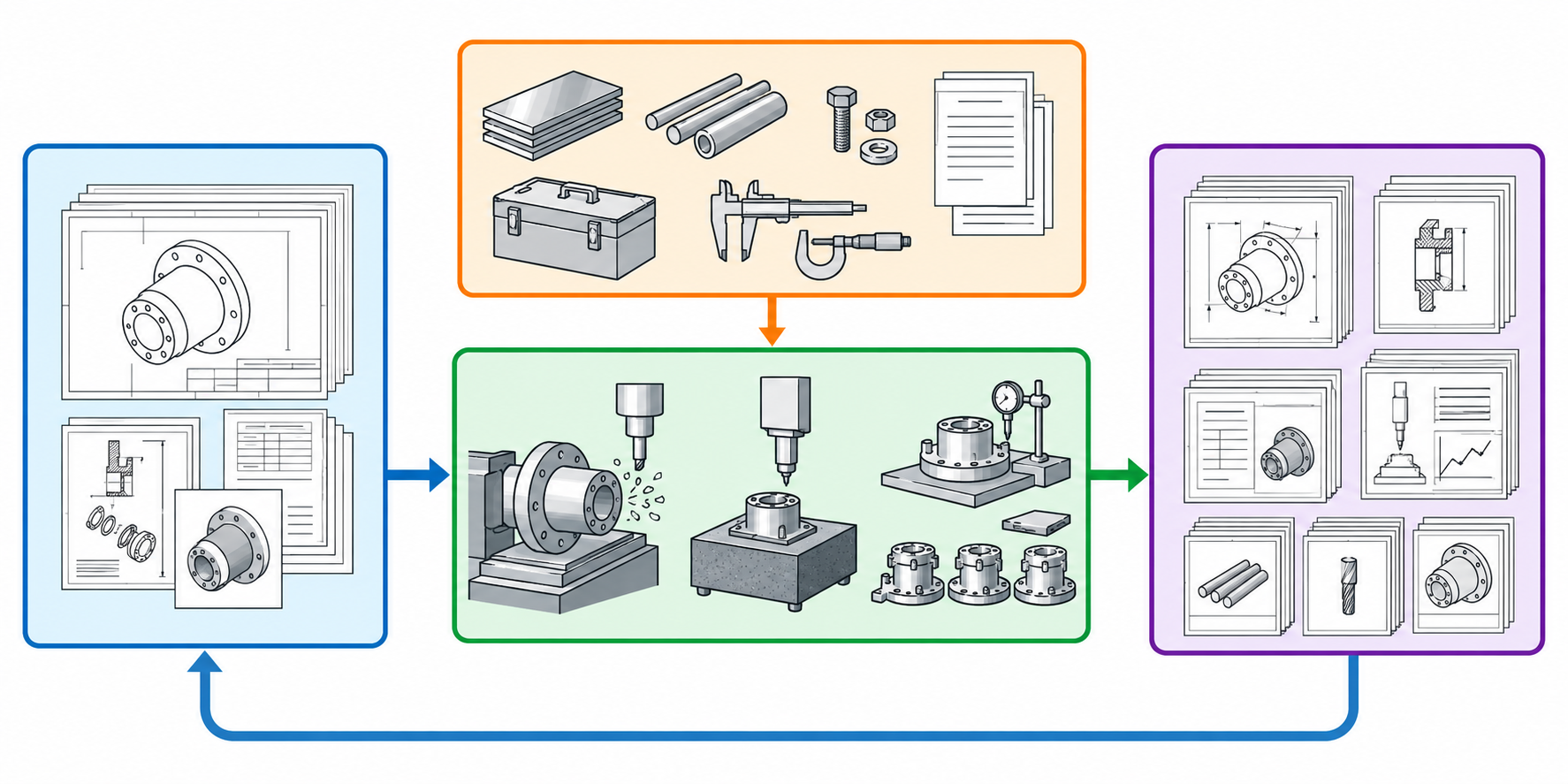
Label each deliverable by its role:
| Package element | What to state |
|---|---|
| Authoritative design definition | Model or drawing identity, revision, units, coordinate context, and the representation that controls the result. |
| Geometry derivative | Purpose of the exact or faceted representation, known limitations, and whether it is suitable for the recipient’s task. |
| Engineering semantics | Required PMI, characteristics, datums, materials, finishes, notes, or classifications and their associations. |
| Process context | Workplans, working steps, setup/orientation, machine or tool context, and whether these are transferred or recreated. |
| Additive payload | Required material/property, lattice, production, support, simulation, or slice information, with the exact extension and revision where relevant. |
| Inspection and quality inputs | Measurement plan, resources or templates, characteristic identifiers, result format, and link to the design revision. |
| Dependencies | External references, linked model parts, libraries, profile definitions, and any access or version prerequisite. |
| Recipient-generated outputs | CAM operations, toolpaths, posts, build preparation, reports, or measurement results that the supplier creates and must return. |
The labels matter because production and quality models can contain linked information beyond a visible shape. ISO 14649-10 describes general process data including workplans, working steps, and machine functions. QIF material describes a chain from design and PMI through planning, resources, results, analysis, and reporting. 3MF provides an additive package model with independently scoped extensions. None of those models is a universal supplier checklist or proof of a particular recipient’s support.
For additive work, ISO/ASTM 52951:2026 describes a scenario-specific, modular data package and a reference thread from design through acceptance, including areas such as configuration management, feedstock, quality control, and inspection. Its public scope is based on PBF-LB/M and explicitly does not impose a production execution plan. If process monitoring is part of the handoff, ISO/ASTM 52953:2025 adds a separate, metallic-PBF-LB-scoped data registration concern for multimodal monitoring and quality-control data. List the repository, linkage, and return responsibility explicitly rather than assuming that a 3MF package contains or preserves them.
For metal powder-bed-fusion parts, ISO/ASTM 52908:2023 adds a separate, process-specific prompt for qualification, quality assurance, post-processing, and inspection/testing. Its public preview identifies documentation for the produced part, facility, and quality assurance, along with post-build work and test areas such as material, mechanical, surface-quality, geometrical, and non-destructive testing. Treat this as a bounded inventory prompt: the preview does not expose the complete requirements, define a file package, or establish a supplier route or acceptance result. Confirm the applicable clauses and customer/provider agreement for the actual part.
Keep electronics design and process records distinct
For printed boards, IPC-2581C’s public scope describes a single XML data file for board and board-assembly manufacturing, assembly, and inspection information. That is a useful design-package example, but the public scope is not evidence that a particular ECAD tool, fabricator, or inspection system supports every section. IPC’s described DFM profile workflow is a separate check against a selected profile; its CFX equipment qualification is tied to a specific model, software version, and declared capability set. A profile report or CFX listing does not establish acceptance of a produced board.
For wire harnesses, OPC 40570 v1.0.0 models operational process outputs such as
crimp height and width, insulation-crimp height, a force curve, cut length,
seal position, and stripping length. It calls for an overall
ResultEvaluation when a process-output subtype is used in result data. Those
measurements describe process results; they are not electrical connectivity
data and do not by themselves show that results map to the intended design
characteristic, physical harness, or acceptance decision. Name the part and
revision, job or lot, tool/process execution, result selection, and required
return evidence in the supplier brief, then verify the actual endpoint
mapping.
Supplier provenance can be recorded separately from the full process payload. NIST IR 8536 presents a conceptual traceability framework that links manufacturing events and tracked entities while allowing supplemental validation evidence, such as inspection records, to remain in a separate or restricted system. Use this as a question about event identity, chronology, links, and what evidence can be shared. It is not a CAD mapping, universal supplier schema, contract requirement, or part-acceptance rule.
Declare regeneration responsibility
For each missing or derived element, choose a clear disposition:
- Must arrive unchanged: design identity, critical characteristics, or other information whose alteration changes the agreed result.
- May be regenerated: local CAM operations, toolpaths, supports, or measurement execution details when the recipient is responsible for them.
- May be used as context: operation hints, simulation, setup notes, or convenience derivatives that help the recipient but do not replace checking.
- Must be returned: generated process output, inspection results, reports, or traceability records needed for the next decision.
Do not let a recipient silently recreate an omitted design or quality requirement. If the package does not establish whether a process, identifier, association, or extension survives, record the item as unresolved and verify it with the named recipient.
A purpose-led handoff brief
Recipient and operation:
Authoritative design identity and revision:
Required geometry, units, orientation, and coordinate context:
Required PMI, characteristics, or engineering semantics:
Process/tool/setup information transferred or regenerated:
Additive extensions or production payload, if applicable:
Inspection plan, resources, results, and traceability:
External dependencies and version/profile requirements:
Recipient-generated outputs and return requirements:
Acceptance evidence and responsible approver:
Fill this brief before deciding that a file list is complete. For subtractive handoffs, see CAD-to-CAM/CNC Handoffs. For additive payload, see Additive-Manufacturing Exchange Beyond the Mesh. For sheet-metal derivatives, see Sheet-Metal Flat-Pattern Handoffs. For inspection traceability, see Inspection-Ready Digital Handoffs and Design-to-Inspection Identity Links. For additive monitoring and inspection records, see Additive Monitoring and Inspection Data.
Keep acceptance conditional
The final package requirement depends on the recipient’s system, release, process, and objective. A supplier may accept a geometry package and rebuild manufacturing data locally, while another route may require transferred process or quality relationships. The responsible question is not “Which extension should I send?” but “Which information must this recipient use, what may it regenerate, and what evidence will show that the intended result was preserved?”